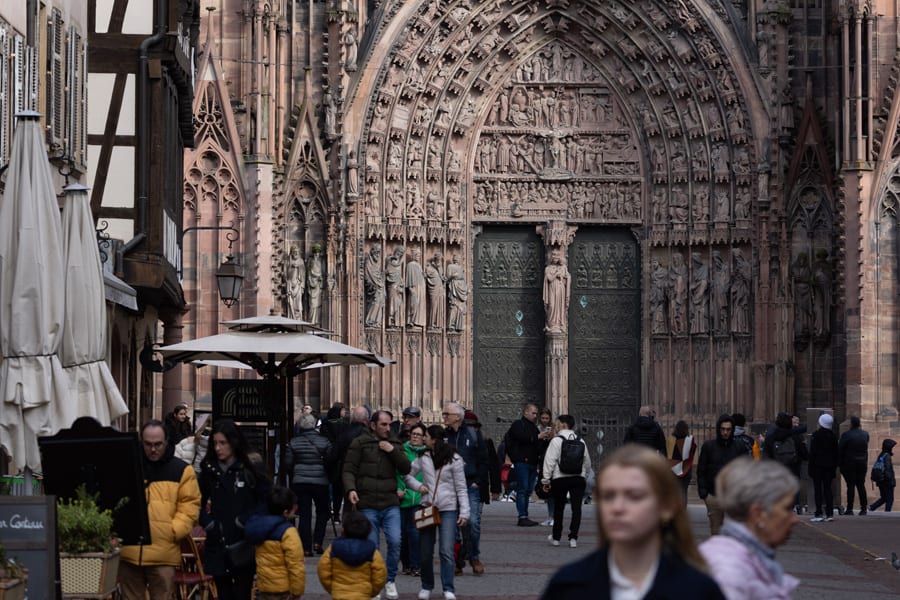
Above the main portal of the Bern Minster stands one of the most psychologically complex pieces of Late Gothic sculpture in Europe. Most visitors walk beneath it without stopping. They should stop.
Küng's sculpture deserves evaluation on what it actually is, not on what it managed to avoid.
You are standing in Münsterplatz in Bern, looking up at a wall of stone that is trying to frighten you into goodness. The portal of the Bern Minster — completed between 1490 and 1495 by the master sculptor Erhart Küng — is a machine for producing dread, and it works. Not through abstraction or theological shorthand, but through an almost oppressive specificity: 47 large statues, more than 170 individual figures, each one a distinct psychological portrait. The medieval mind, we are often told, produced art that was symbolic rather than naturalistic, concerned with type rather than individual. Küng's portal makes that claim very difficult to sustain.

The Architecture of Terror
The composition is arranged with the logic of a court proceeding, which is precisely what it depicts. At the apex, Christ sits in judgement. Below him, the Archangel Michael holds the scales — the weighing of souls, *Psychostasis*, one of the oldest images in the Christian visual vocabulary — while the Virgin Mary and John the Baptist kneel as intercessors, their postures communicating the specific grammar of supplication that Küng's contemporaries would have read instantly. To the left, the saved process toward Heaven in orderly columns; to the right, the damned are consumed by Hell in configurations of almost choreographed chaos.
The spatial logic is deliberate and important. Every person who entered this cathedral passed beneath this portal. You were meant to look up. You were meant to see yourself sorted, categorised, weighed. The portal is not decoration. It is argument.
The portal of the Bern Minster is not decoration. It is argument.
What the Damned Are Actually Doing
The received reading of Last Judgement iconography treats the tormented figures as illustrations of sin — cautionary emblems rather than individuals. Spend time with the damned side of Küng's composition and that reading becomes inadequate. These are not types. They are people mid-experience, caught in the specific physical and psychological texture of their damnation. Faces are contorted not in the generic grimace of symbolic suffering but in the particular distortion of bodies under pressure — jaws wrenched sideways, eyes at different angles, mouths that have lost all composure.
This is what distinguishes Küng's work from the flat moralism of lesser Late Gothic sculpture. He understood that terror is specific. A demon dragging a figure downward is terrifying not because it represents hell abstractly but because the figure's body responds to the pulling — weight shifts, the torso twists, the attempt at resistance reads in the shoulders. This is observed movement, not imagined symbolism. Whether Küng worked from life studies, from corpses, or from some other now-lost practice, the anatomical attention is unmistakable.

The saved, by contrast, are rendered in a calm so pronounced it reads almost as vacancy — beatific faces, measured gestures, robes that fall without urgency. The contrast is not accidental. Küng understood that peace is harder to make visually interesting than anguish, and rather than straining after ecstatic expression on the saved side, he let their stillness do the work. Next to the violent specificity of the damned, the saved figures carry their composure like armour.
Testing the Survival Narrative
The story most often told about this portal is one of miraculous preservation: that it survived the Swiss Reformation — the wave of iconoclasm that swept through Bern in 1528 and destroyed enormous quantities of religious imagery — because it was somehow overlooked, or protected, or simply too large to dismantle quickly. This survival is offered as proof of the portal's special status, a kind of retrospective consecration by history.
The evidence is more complicated. The Reformation in Bern proceeded through organised removals rather than mob action in many cases, and the cathedral's authorities had negotiating room that smaller parish churches did not. The portal's survival probably has less to do with its artistic greatness than with the logistical difficulty of removing 170 figures from a structural element above a functioning entrance. Survival is not the same as recognition. The portal stood through the sixteenth century not necessarily because anyone decided it was worth saving, but because demolishing it would have been an engineering project rather than an act of faith.
This matters because the heritage narrative around the Bern Minster tends to frame the portal's survival as confirmation of its value — as if history has already voted. But Küng's sculpture deserves evaluation on what it actually is, not on what it managed to avoid. What it actually is, looked at closely and without the halo of survival mythology, is one of the most psychologically sophisticated large-scale sculptural programmes produced in the German-speaking world in the fifteenth century.
Küng's sculpture deserves evaluation on what it actually is, not on what it managed to avoid.
The Originals and Their Absence
There is a further complication that the tourist literature tends to underplay: what you are looking at above the portal today is not what Küng made. The figures currently in place are high-quality replicas; the originals were relocated to the Bern Historical Museum in the late twentieth century after acid rain and urban pollution began accelerating their deterioration. The decision was conservationally correct and practically inevitable, but it creates an interesting epistemological situation. The portal reads as a unified fifteenth-century artwork. It is, in physical fact, a simulation of one.
I am not arguing that the replicas fail — they don't, and the scholarship that produced them was serious. But standing beneath them knowing this, you become aware of the gap between the experience of the portal and the reality of it. The thing that Küng actually touched — the stone he worked, the surface that holds the accumulated micro-decisions of his chisel — is indoors, in a museum, removed from the architectural context that gives the composition its meaning. The portal has the form of the original. The original has been extracted from it.
What This Stone Is About
The Last Judgement at the Bern Minster is, finally, about the problem of visibility — who is seen, how they are categorised, what their body communicates about their moral status. Küng was working in a theological framework that believed damnation and salvation were ultimately legible on the body, that the soul's condition would be expressed in flesh. His achievement was to make that belief viscerally credible through sculptural means: not by asserting it as doctrine but by showing it as physical reality.
That is still, five centuries later, a disturbing proposition. The idea that character is readable in the face and posture — that the damned look damned — has not been confined to medieval theology. Every era finds new ways to claim it can sort human beings by visible type. Küng's portal is unsettling not because it is remote from us but because the logic underneath it is not. Stand beneath it long enough, looking up at the scales in Michael's hands, and the question it raises about who gets to do the weighing becomes less medieval by the minute.