Pascal wrote, in the seventeenth century, that all of humanity's problems stem from the inability to sit quietly in a room alone. It was hyperbole, but the kind that lodges in the mind precisely because it contains a disconcerting amount of truth. We have built a civilisation on the principle that being alone is a problem to be solved rather than a state to be inhabited.
Consider how we use language. We speak of 'killing time', of being 'stuck' with our thoughts, of the relief of company. Loneliness — involuntary solitude — is rightly recognised as a crisis of public health. But somewhere in our anxiety about loneliness, we have confused it with solitude, which is something entirely different: chosen aloneness, the condition that made possible the Meditations, the Confessions, and almost every great work of sustained thought.
The Disappearance of the Interior
What the smartphone has done — and this is not a technological argument against phones, merely an observation — is colonise the spaces that used to constitute our interior life. The queue. The commute. The minutes before sleep. These were once the territory of reflection, of the half-formed idea, the unattended feeling. Now they are attended — by content, by connection, by the gentle anxious monitoring of social metrics.
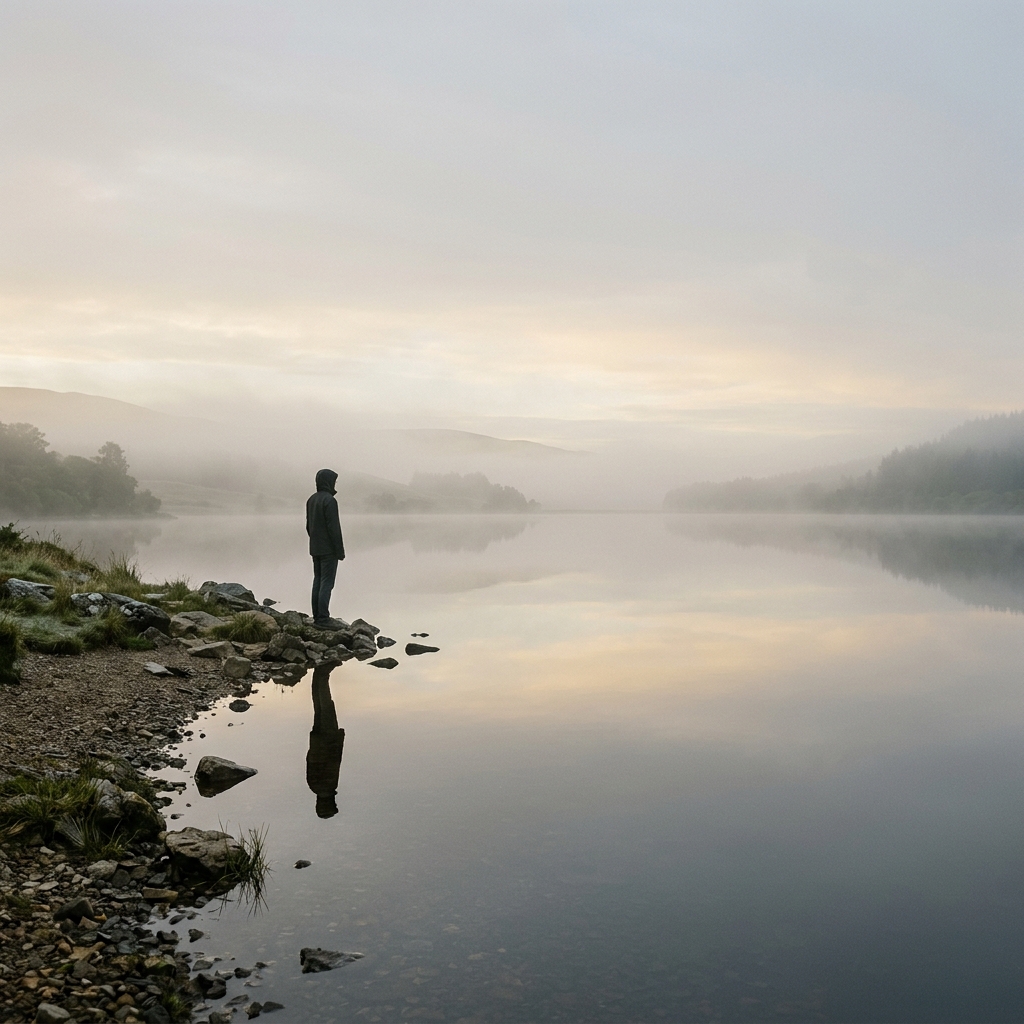
We have confused loneliness with solitude. One is involuntary absence; the other is the condition that made possible almost every great work of sustained thought.
I do not think this is a conspiracy. The attention economy is simply doing what markets do: meeting a demand. We have a deep, possibly mammalian need for social contact, and when we are alone, we feel its absence acutely. The phone offers a simulation of presence that is close enough to soothe, but not quite real enough to nourish. We refresh endlessly because we are never quite full.
The Practice
What would it look like to recover solitude — not as deprivation, but as practice? I have been experimenting with what I can only call deliberate aloneness. A walk without the phone. A meal without reading. An evening with no plans and no screen. The first such evenings were, I admit, uncomfortable. I noticed how rarely I allowed a thought to complete itself before reaching for the next stimulus.
But something happens in the discomfort, if you wait long enough. The mind, deprived of distraction, turns to its own inventory. Problems that had felt urgent become smaller. Questions that had seemed unanswerable begin to take shape. This is not mysticism; it is simply what the mind does when you stop interrupting it.
Pascal, who wrote so sharply about our inability to sit alone, was himself a man of extraordinary interior richness. He was also ill, frequently in pain, and died at thirty-nine. Perhaps he understood something about what it means to be truly alone — stripped of distraction, forced to face the self — that only difficulty teaches.